A letter from our CEO
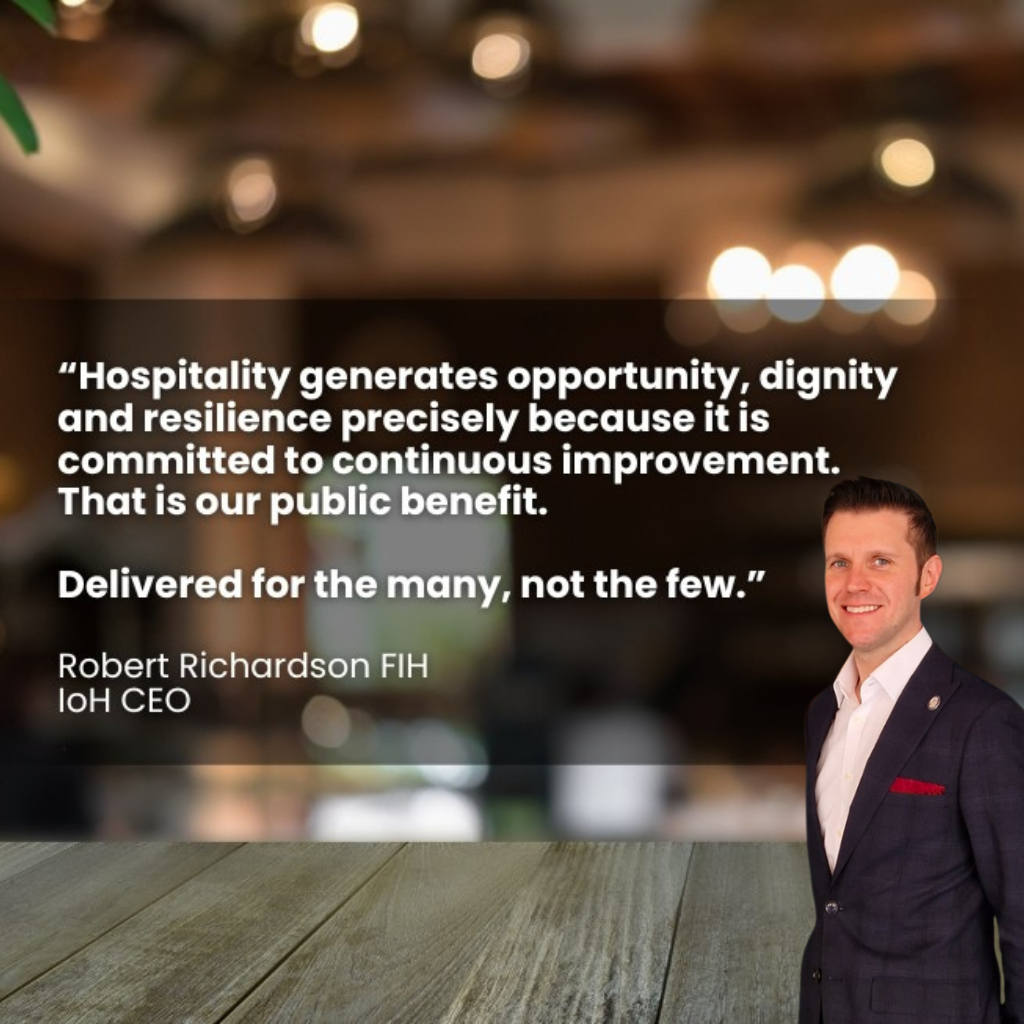
A Reflection on Public Benefit – A Letter from Our CEO, Robert Richardson FIH.
Over recent weeks, I have been reflecting on what public benefit truly means in the context of hospitality, not simply as an industry, but as a profession. I share these thoughts with you, our global hospitality family, because the answer matters. It shapes how we lead, how we develop our people and how we position hospitality on the world stage.
Hospitality is a global industry worth more than 4.5 trillion US dollars and employs over 320 million people. Those figures demonstrate scale and influence. Yet public benefit is not defined by economic weight alone. Its real measure is found in the lives we help shape, the standards we uphold and the communities we serve.
A few years ago, I met a young professional at the very beginning of her career. She was enthusiastic and ambitious, the first on the floor and the last to leave. Her potential was evident. However, over time, her attendance slipped, and her engagement declined. Her home environment did not value career ambition. Early starts and late finishes were discouraged. Expectations at home began to undermine her progress at work.
What changed her trajectory was not luck. It was professional structured development. Mentorship, clear expectations, accountability and ongoing learning restored her confidence and direction. She made courageous decisions, progressed and is now an area revenue manager based in Paris. Her success reflects social mobility, certainly, but it also reflects the power of a profession that invests in standards, capability and continuing development.
I later met a chef whose journey began in homelessness. Through an entry-level development programme within a hotel company, she gained training, stability and a defined pathway for growth. Hospitality provided more than employment. It offered belonging, structure and the opportunity to build expertise. She went on to excel across multiple properties.
Today, she also gives back by volunteering her time and skills to cook for a homeless shelter with the support of her employer. The profession that equipped her with capability and confidence now enables her to serve others, because when development is structured and standards are clear, the impact extends far beyond the individual.
More recently, I attended the annual awards for The Crumbs Project, a charity delivering endorsed hospitality training for adults living with disabilities, neurodivergence, mental health conditions and acquired brain injuries. Through structured programmes and supportive environments, trainees achieve recognised qualifications aligned to professional standards.
You may reasonably ask why I am sharing these stories. I do so because public benefit is best understood not as theory, but as practice. It is seen most clearly in individual journeys that reflect the wider strength and structure of our profession.
That is the multiplier effect of professional hospitality, a profession that continually develops its people within the communities it serves. One individual is supported and developed and, in turn, goes on to support others. Skills are passed on. Confidence is shared. Opportunity expands beyond the original investment.
What begins as structured training and professional development for one person becomes wider economic participation, stronger local networks and renewed community resilience. Defined standards and qualifications create competence. Competence builds confidence. Confidence drives contribution.
Here again, the balance between compassion and competence is clear. Individuals who might otherwise face exclusion gain sustainable employment. At the same time, they develop skills that meet the expectations of a modern, globally connected profession. Economic participation rises. Confidence grows. Communities benefit. Public benefit is delivered not only through inclusion, but through excellence.
This is where the role of a professional body becomes critical. Public benefit is strengthened when standards are clearly defined, competence is assured and ethical practice is expected and upheld. A profession that commits to structured entry routes, recognised qualifications, and ongoing continuing professional development does more than create jobs. It safeguards quality, protects those we serve and builds public confidence.
Excellence does not happen by accident. It is sustained through accountability, lifelong learning and independent oversight in the public interest. When compassion is underpinned by competence, and opportunity reinforced by standards, the result is a profession that not only changes lives but earns and maintains society’s trust.
Public benefit in hospitality is realised every time we invest in competence, ethical practice and growth. It is realised when our members commit to staying at the top of their game, adapting to change, refining their expertise and mentoring others. Standards and humanity are not competing priorities. They are interdependent.
As members of the Institute of Hospitality, wherever we are in the world, we share both the privilege and the responsibility of shaping a profession that delivers economic value and lasting social impact.
Globally, hospitality supports more than 320 million livelihoods. In many countries, it represents between 8 and 10 per cent of national employment and a similar proportion of GDP. Small and medium-sized enterprises make up the vast majority of hospitality businesses, embedding opportunity directly within local communities. When we strengthen professional standards and invest in continuing development, we strengthen not only individual careers, but local economies and social cohesion.